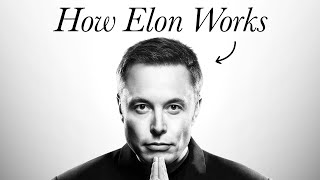
This is the stripped operating system Elon has repeated across Zip2, PayPal, SpaceX, Tesla, and beyond, not another biography or personality study. You'll walk away with the exact interlocking principles—idiot index costing, maniacal urgency, and belief transfer—that compound into results others call impossible.
- 1Elon treats cost as physics: he calculates the idiot index (finished price vs raw materials) then destroys the multiplier, turning $120k parts into $5k ones and $2M cranes into $300k.
- 2Maniacal urgency is the default operating system, not a tactic; he halves already-impossible deadlines and values one saved day over $90k, creating compounding speed even when targets are missed.
- 3Belief transfer turns epochal missions into irresistible magnets for talent and capital, while vertical integration and relentless deletion keep design, engineering, and manufacturing in tight, painful feedback loops.
Can these principles be institutionalized and scaled by leaders without Elon's pain tolerance and personal intensity, or do they require the founder's full-spectrum obsession to keep working?
The Enduring Operating System Elon Musk Uses to Build Companies
Core Question: What small set of principles has Elon Musk repeated across three decades, seven companies, and countless near-death experiences to achieve results others call impossible?
At a Glance
- This is a 60-hour distillation of Walter Isaacson’s 615-page biography that ignores the politics and drama to extract only the repeatable company-building methods.
- Elon treats every endeavor as war: he is wired for it, works with maniacal urgency, and demands the same from others.
- Cost control is not a tactic but an obsession; he uses “first principles” and the “idiot index” to slash expenses by factors of ten or more.
- He refuses to accept standard industry practice, questions every requirement, deletes relentlessly, and keeps design, engineering, and manufacturing physically together.
- Belief transfer is his superpower: when Elon truly believes something is possible, others follow even when the odds look insane.
- The real insight is repetition: the same handful of ideas appear, reappear, and compound over 30 years.
What the Speaker Is Really Doing
The speaker is not writing another Elon hagiography or political commentary. He has read and re-read Isaacson’s biography, edited 40 pages of notes down to the signal, and presents the material in strict chronological order so the listener can watch the same principles surface in Zip2, PayPal, SpaceX, Tesla, and later ventures.
He functions as an archaeologist of mindset: every time Elon repeats a phrase or behavior across decades, the speaker flags it. The goal is not to admire the man but to isolate the operating system so others can decide which parts to adopt. The narrative arc moves from a demanding 20-something founder sleeping under his desk to a 37-year-old having night terrors while simultaneously keeping two companies alive, showing that the principles never softened even as the stakes rose. The speaker repeatedly contrasts Elon’s approach with normal industry practice, making clear this is diagnosis, not universal advice.
The Core Ideas
Obsess over cost through first principles and the “idiot index.”
This is not obvious because most executives treat cost as a spreadsheet line item. Elon treats it as physics. He calculates how much more a finished rocket costs than its raw materials and calls the multiplier the “idiot index.” Rockets scored at least 50 times.
“Elon employed first principles thinking, drilling down to the basic physics of the situation and building up from there. This led him to develop what he called an idiot index which calculated how much more costly a finished product was than the cost of its basic materials.”
Evidence appears everywhere: a $120,000 supplier part replaced for $5,000 because it was “no more complicated than a garage door opener”; NASA latches at $1,500 replaced by a modified bathroom-stall latch costing $30; military crane regulations questioned and revised, dropping cost from $2 million to $300,000. The speaker notes the word “cost” appears 158 times in the book. ▶ 16:43
If this is true, every industry has hidden multipliers waiting to be destroyed. Companies that master the idiot index gain permanent advantages because, as Carnegie (whom Elon studied) said, profits and prices are cyclical but cost savings are permanent.
Demand a maniacal sense of urgency as the operating principle.
Elon repeats the phrase so often it becomes a mantra. ▶ 9:49 He sets deadlines everyone calls impossible, then cuts them in half again. When an engineer protested, Elon replied coldly, “Then when I ask for something, you fucking give it to me.”
The speaker quotes an early SpaceX employee: everything was a function of burn rate. Elon would refuse a $2,000 part but spend $90,000 to rent a plane because it saved one workday. The result? Even though SpaceX missed most of Elon’s schedules, they still beat every peer. Urgency created its own compounding advantage.
What follows is uncomfortable: most organizations optimize for comfort. A maniacal sense of urgency looks irrational until you compare output. The speaker notes half the book is Elon telling people to go faster.
Maintain total control by staying vertically integrated and eliminating middlemen.
From Zip2’s fake server rack to SpaceX and Tesla, Elon refuses to outsource core components. He wants engineers and designers to feel immediate pain when their decisions create manufacturing problems, so he physically clusters the teams.
“Separating the design of a product from its engineering was a recipe for dysfunction. Designers had to feel the immediate pain if something they devised was hard to engineer.”
He owns the factory that builds the machine that builds the car. ▶ 19:40 The speaker points out this mirrors early Ford and Carnegie, then contrasts it with America’s later drift into outsourcing. The implication is that daily iteration and tight feedback loops become impossible when design and production are separated by oceans and contracts.
Question every requirement, simplify relentlessly, and delete.
Elon’s algorithm begins with “question every requirement.” ▶ 20:40 He insists engineers name the actual human who created any specification; “the military” or “legal” is unacceptable. All requirements are treated as recommendations except those imposed by physics.
He walks assembly lines and challenges every part: delete, trim, simplify. Removing one kilogram from a rocket creates multiplier savings in fuel. The speaker says half the book is Elon yelling at people to delete, edit, and simplify. This directly challenges the default human tendency to add rather than subtract.
Frame the mission with epochal significance and transfer belief.
Elon does not start with business models. ▶ 12:45 He starts with a mission—making humanity multiplanetary—and backfills the economics later. He tells people they are not building cars or rockets; they are choosing whether Earth remains a single-planet civilization.
“To have a base on Mars would be incredibly difficult and people will probably die along the way… But it will be incredibly inspiring and we must have inspiring things in the world. Life cannot be merely about solving problems. It also has to be about pursuing great dreams.”
The speaker calls this “belief is irresistible.” ▶ 39:17 Even when Elon’s plans sounded like crazy talk, people followed because he believed so completely. This is why showmanship matters: dramatic demonstrations and public storytelling convert belief into capital and talent.
Connecting the Dots
The power comes from the interplay. First-principles cost obsession only works when paired with maniacal urgency and total control. Deleting parts only matters when the mission feels epochal enough to justify the pain. The principles reinforce each other and compound across decades. What looks like a personality defect—refusal to accept work-life balance, contempt for middlemen, inability to be collegial—becomes a coherent system when viewed as a single operating philosophy repeated without deviation.
Where the Value Really Lies
The value is not in novelty. These ideas have appeared in many founder biographies. The value is in the clarity of synthesis and the chronological tracking that shows one person applying the same small set of ideas relentlessly across wildly different industries for thirty years. The evidence is strong because the speaker only uses examples that repeat; the book’s length becomes an asset rather than a burden. This is clarification and framing, not counter-consensus revelation. It shows that greatness often looks like boring repetition of a few correct principles under extreme pressure.
The Open Question
Can these principles be applied at smaller scales without destroying people or creating toxic environments? The speaker shows the personal cost—Elon’s night terrors, failed marriages, employees pushed to exhaustion—but does not resolve whether the intensity is inherent to the system or can be modulated while preserving results.
One Line to Remember
“Elon works by turning a handful of principles into mantras and repeating them without deviation for decades until reality bends.”
Further Reading
These X posts extend "How Elon Works" into critiques of its founder-centric model, real-world applications by ex-employees, adjacent domains like software and military strategy, and counterpoints highlighting risks and limits—offering bridges from Elon's interlocking principles to broader scalability debates and failure modes.[1][2]
Expert Pushback & Institutionalization Debates
Zac Valles (ex-SpaceX/Tesla) on the "responsible engineer" framework
Details the structural machinery—tiny teams with extreme ownership, flat orgs, factory-floor engineering, and existential sustaining efforts—that enables Elon's principles at scale, directly addressing if they can outlive the founder by institutionalizing feedback loops and technical leadership.[1]
Turner NextGen AI's "deviation lens" on Musk's system
Analyzes high performance from direct problem engagement under load but flags risks like founder dependency and disrupted continuity, probing the unanswered question of scaling without Elon's personal intensity.[3]
Applied Practitioner Insights
Mustafa on Elon's "different axis" of operation
Breaks down 10 ways Musk violates human defaults—like compressing timelines, bottleneck focus, and physics over narrative—mirroring the video's urgency and cost obsession, with war stories on why this compounds into non-linear results.[2]
Dustin on the "mathematical equation" killing corporations
Elon exposes how punishing failure breeds incrementalism; balancing risk-reward for bold bets echoes maniacal urgency, adding a incentive mechanics layer to why belief transfer and deletion loops must align.[4]
Adjacent Territories & Counterpoints
Codie Sanchez on SpaceX exec culture
Echoes vertical integration via physics-first questioning and "paper walls," but stresses do-to-say ratios and ego-free feedback as transmissible to non-Elon teams—contrasting the video's personality emphasis with cultural levers.[5]
Hiten Shah on urgency as a weapon
In software, uncontrolled urgency creates chaos while directed friction removal builds momentum—analogous to halving deadlines, warning of burnout limits when principles lack the video's epochal mission anchor.[6]
K.O.O on laws of the frugal architect
Applies idiot index to cloud engineering (cost as design constraint, data gravity), critiquing managed services as middlemen—sideways to startups copying Tesla without economic reality checks.[7]